Start with the re-engagement question
Import the E-commerce scenario and separate the order, customer, and result assets needed for a campaign decision.
Question for this chapter
What data is needed to propose a customer's next action?
Why this matters now
Defining segment names first makes it easy to invent customers the data does not contain. Start by separating what order behavior, customer context, segment results, and operating metrics can tell you.
Try it
ecommerce.zip Download(32 KB)In the left sidebar, select Collections. On the Collections page, choose the upper-right more (⋯) menu → Import (가져오기) and upload the ZIP. Select Start import after validation completes.
Success looks like this
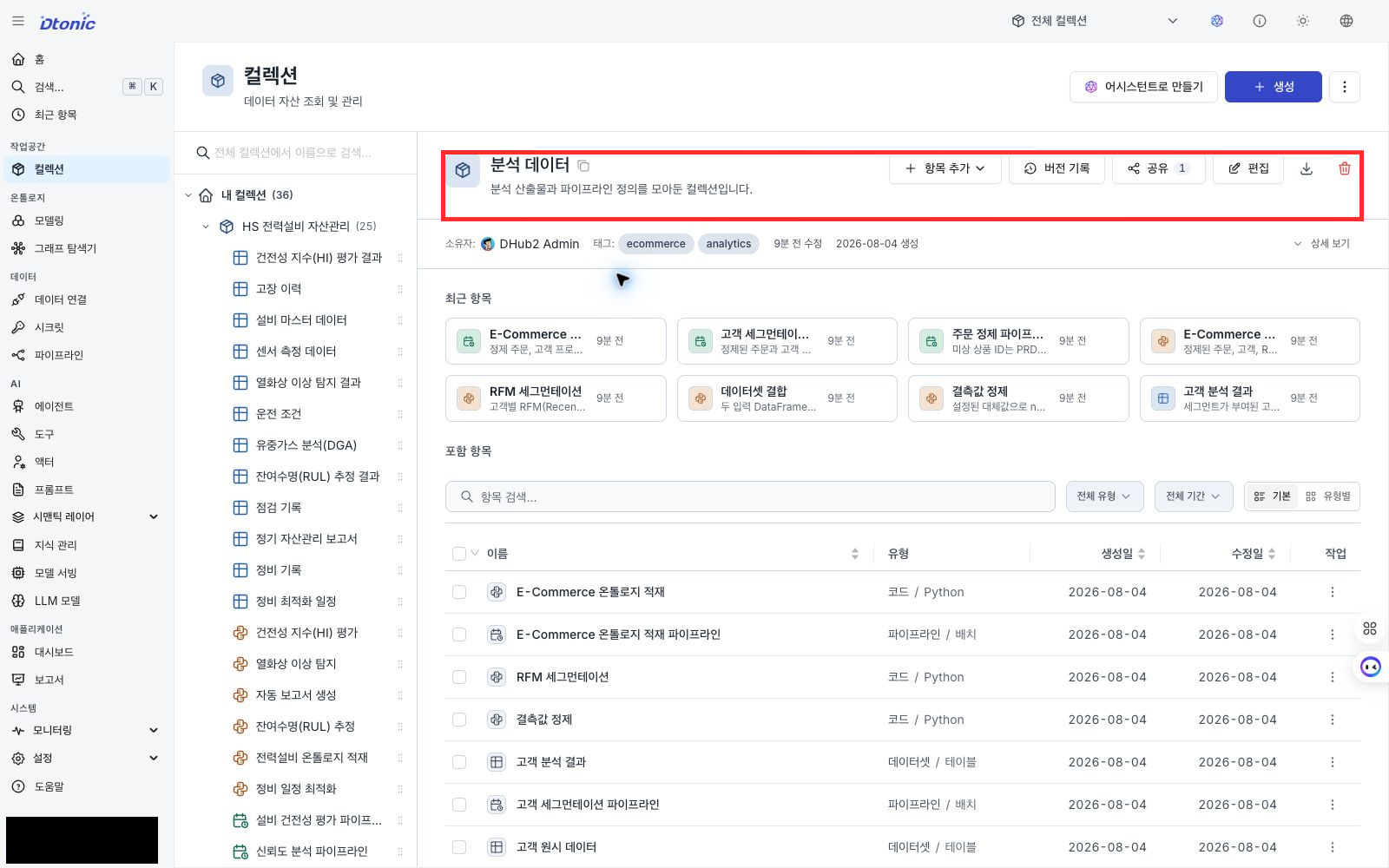
The collection tree shows ecommerce_raw (E-Commerce Raw Data) and analytics (Analytics Data).
analytics contains 100 raw_orders rows and 22 raw_customers rows. The product_manual knowledge
asset belongs to ecommerce_raw.
Interpret the result
| Evidence | Question it answers | Asset to inspect |
|---|---|---|
| Orders | When did a customer buy what, and for how much? | raw_orders |
| Customers | Who are they, and what region and tier are they in? | raw_customers |
| Segments | What state follows from recency, frequency, and spend? | customer_analytics |
| Operating metrics | Where should campaign effort be concentrated? | sales_overview dashboard |
Deep dive — assets imported by the scenario
| Asset type | Count | Contents |
|---|---|---|
| Collections | 2 | ecommerce_raw, analytics |
| Datasets | 4 | raw orders and customers, cleaned orders, customer analytics |
| Codes | 4 | null cleanup, join, RFM, ontology materialization |
| Pipelines | 3 | order cleaning, customer segmentation, ontology materialization |
| Ontology | 3 entities / 2 relations | customers, orders, products, purchase and containment relations |
| Knowledge / dashboard | 1 each | product_manual, sales_overview |
Next decision
You have separated the necessary evidence. Next, reduce 100 orders to usable rows and inspect the empty identifiers that remain after null cleanup.