Enrich inventory with the competitor price
Run the price-update pipeline and interpret the same row across two datasets and the complete output scope.
Question for this chapter
What does the pipeline change in an inventory row, and what does it preserve?
Why this matters now
The dashboard reads price-adjustment candidates from the enriched output. Without verifying the run, an old competitor price could be mistaken for a current observation.
Try it
Open Competitor Price Update under Pipelines and inspect the four connected nodes.
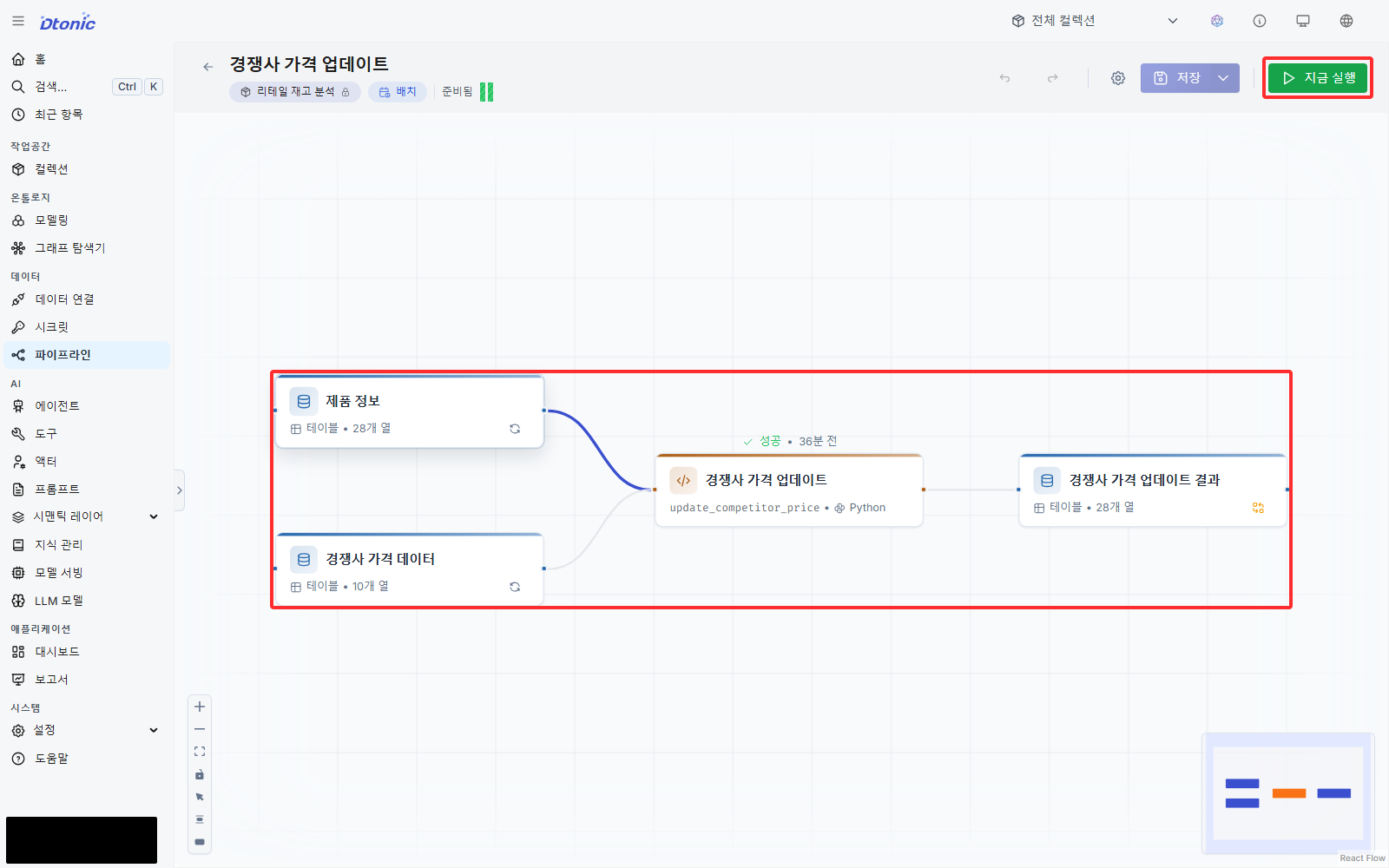
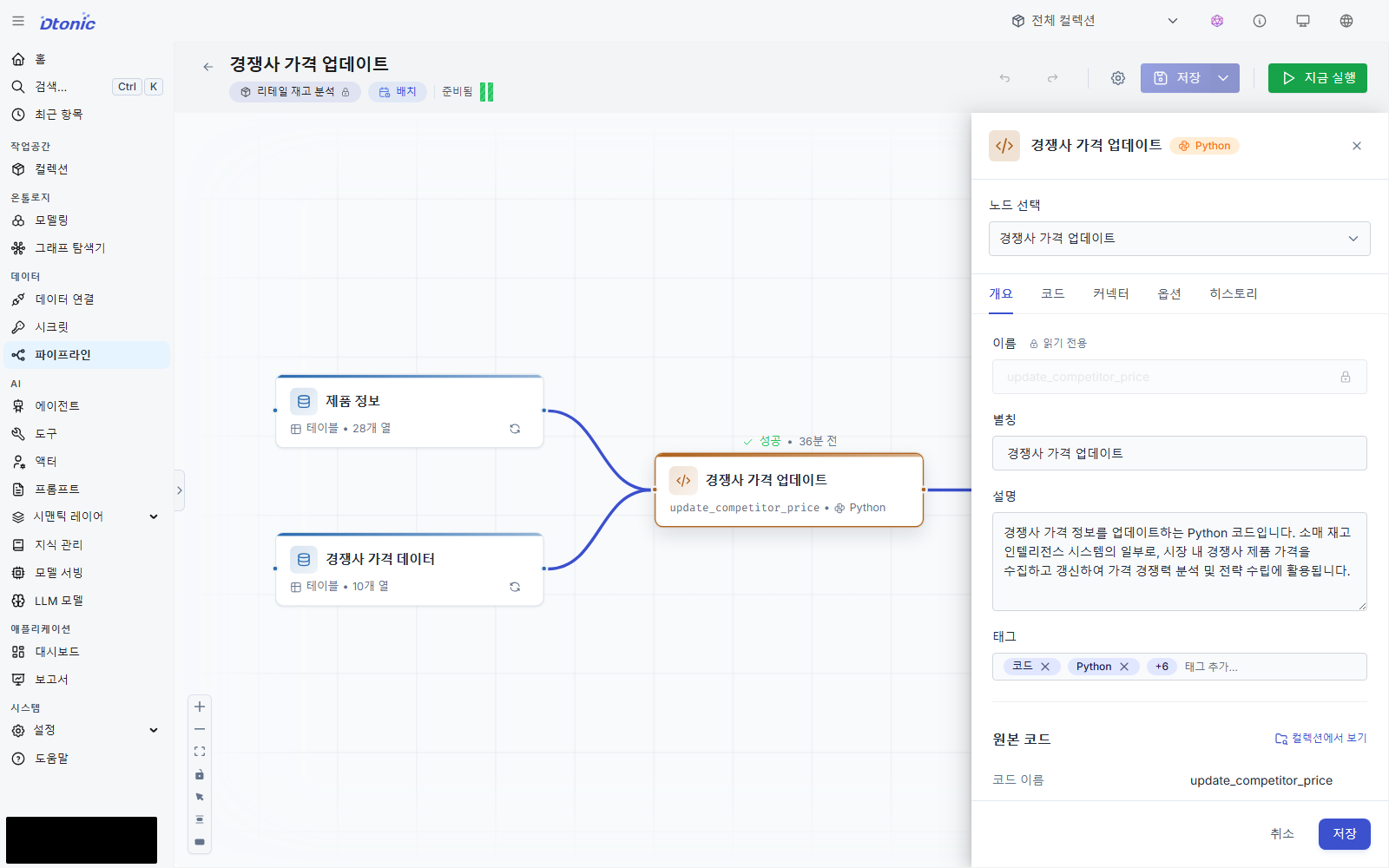
Select the code node. It left-joins the two inputs on item_code and changes only
competitor_price_krw_synth where an observation exists.
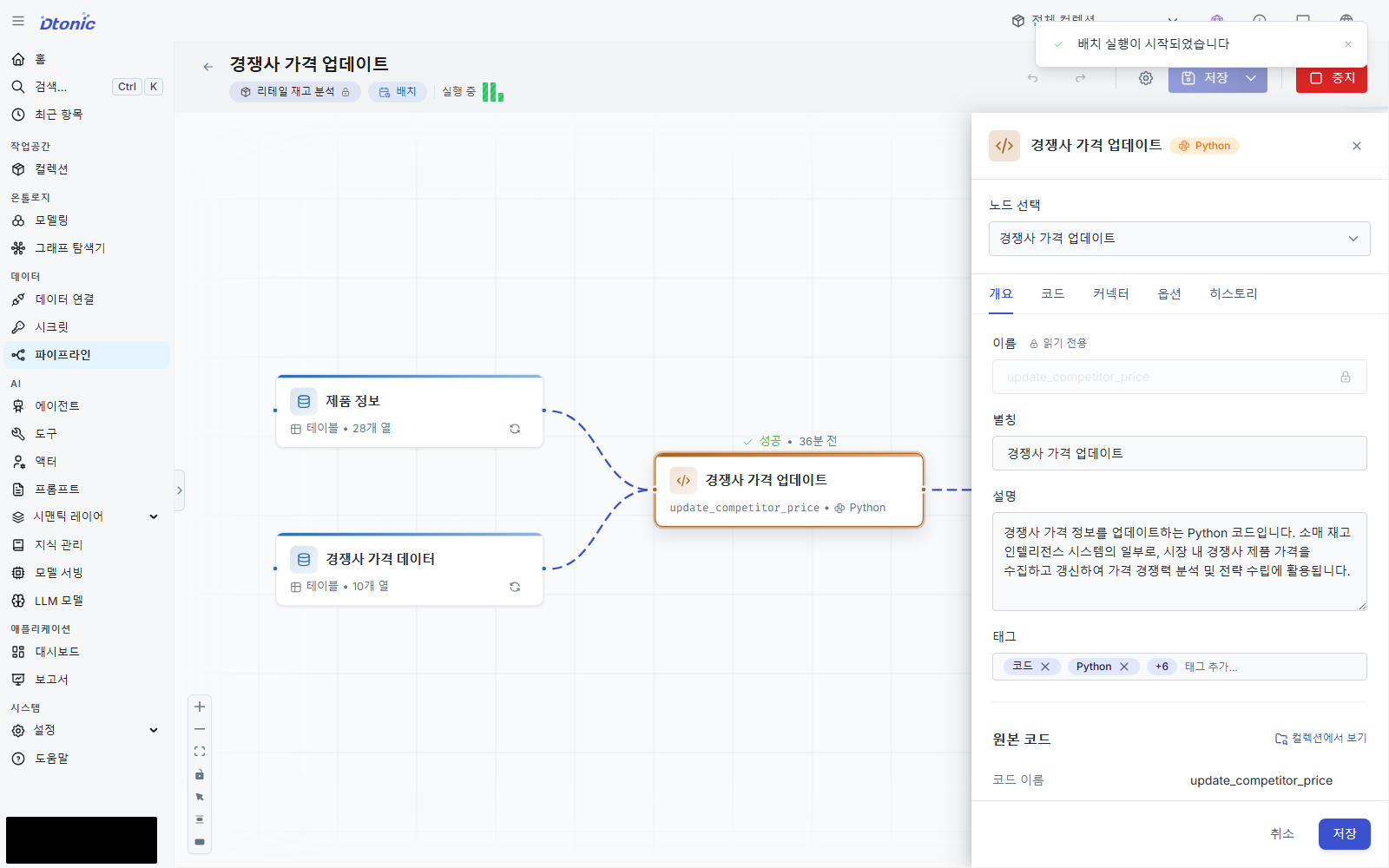
Select Run now in the upper-right. When the run completes, open Data in Competitor Price Update Result and verify the 46,700-row count above the table. Return to the pipeline canvas and verify the orange replace icon on the rightmost output dataset node. Hovering over it shows Overwrite.
Open Product Information, select SQL Scratch Pad, and run this query.
SELECT item_code, branch_name, inventory_qty,
       selling_price_krw_synth, competitor_price_krw_synth
FROM `retail_inventory_intelligence`.`retail_inventory`
WHERE item_code = 7224000894
  AND branch_code = 'GNM0'
  AND `PROD_GRP` = 'YT44402461'
LIMIT 1;
In Competitor Price Update Result, run the same query with the output table name.
SELECT item_code, branch_name, inventory_qty,
       selling_price_krw_synth, competitor_price_krw_synth
FROM `retail_inventory_intelligence`.`update_competitor_price`
WHERE item_code = 7224000894
  AND branch_code = 'GNM0'
  AND `PROD_GRP` = 'YT44402461'
LIMIT 1;
Results to verify
- Above Competitor Price Update Result > Data: 46,700 rows
- On the rightmost output dataset node: the orange replace icon (Overwrite)
| Field | Product Information | Competitor Price Update Result | Interpretation |
|---|---|---|---|
item_code | 7224000894 | 7224000894 | Same product |
branch_name | Gangnam Finance Branch | Gangnam Finance Branch | Branch preserved |
inventory_qty | 51 | 51 | Inventory preserved |
selling_price_krw_synth | KRW 4,490 | KRW 4,490 | Selling price preserved |
competitor_price_krw_synth | KRW 4,500 | KRW 4,670 | Competitor price enriched |
Interpret the result
The pipeline did not append 46,700 new facts. It preserved the original inventory-row structure while enriching the comparison field. Overwrite keeps the output as one current snapshot.
Version history shows version samples but does not provide row-level change summaries. For that reason, counts such as 46,444 changed rows and 256 unchanged rows are not used as success criteria.
Troubleshooting — if the run fails
- Verify that both input datasets have more than zero rows.
- Verify that
price_krwis numeric rather than a string containing a currency symbol. - Verify that the output has a new version and 46,700 rows.
Next decision
Price and inventory are now comparable in one row. Next, expand a product into its branch, region, and supplier relationships to identify the operational context for follow-up.