Summarize condition clues with HI
Combine EQ-005's sensor, inspection, DGA, and operating clues into a Health Index and read it separately from thermal anomalies.
Question for this chapter
How can unlike test results become one view of an asset's current condition?
Why this matters now
Sensor readings, inspections, DGA, and load factors use different units and arrive at different intervals. A decision based on only one value can miss deterioration shown by another clue.
A Health Index (HI) is like a summary page in a medical checkup. It converts several checks to a 0–100 scale and weights them into one view of current condition. Higher is healthier in this scenario. HI does not directly state remaining life or a failure date.
Try it
Open the health_assessment pipeline and select Run. It executes two code assets:
thermal_anomaly_detectioncombines Z-score, IQR, and CUSUM clues from temperature readings.health_index_evaluationcombines equipment age, sensors, inspections, DGA, and operating load.
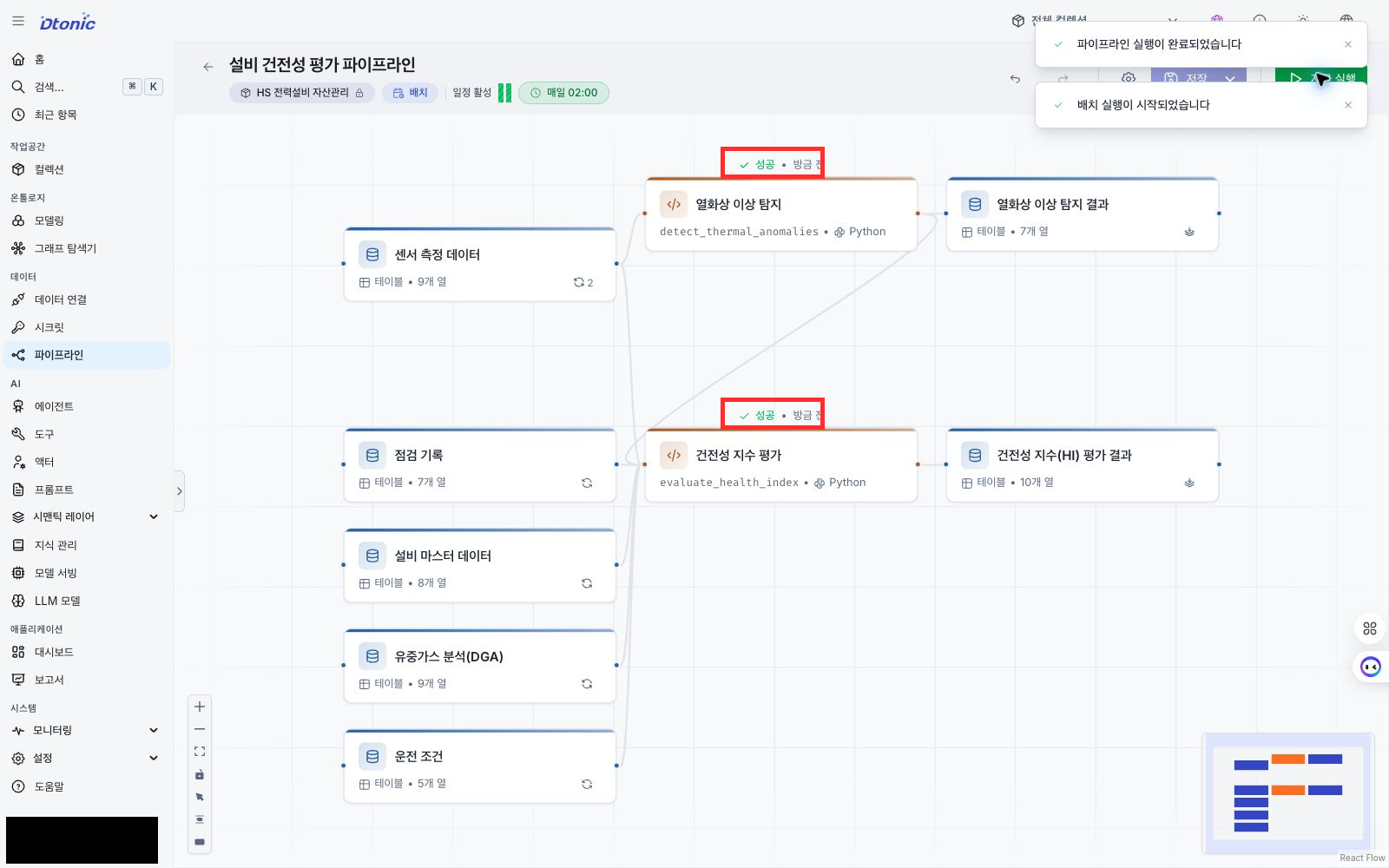
When the run completes, find EQ-005 in health_index_scores.
Successful result
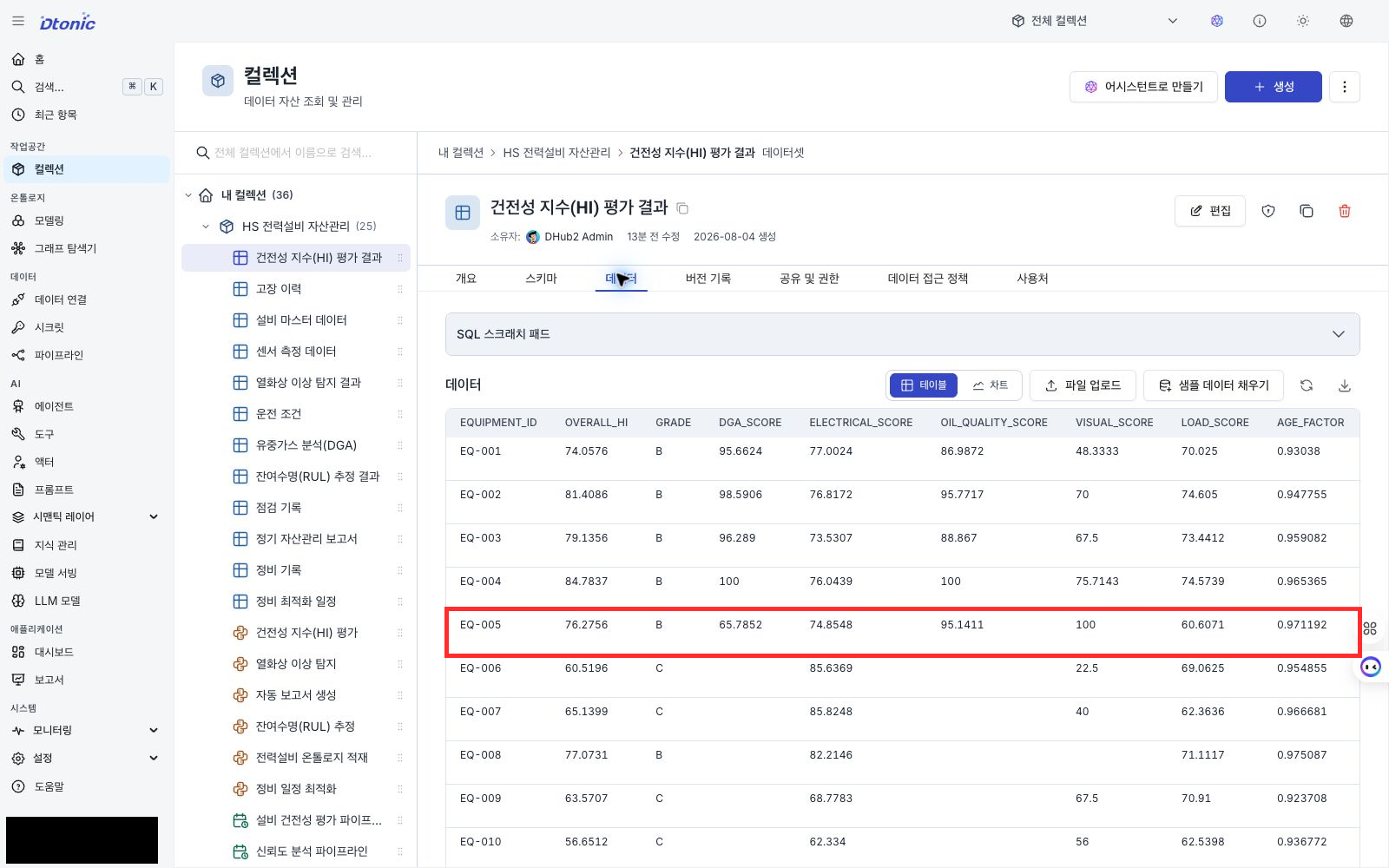
The HI output has one row per asset, ten rows total, with six B grades and four C grades. EQ-005
contains these values.
| Condition clue | Score | How to read it |
|---|---|---|
| DGA | 65.7852 | Latest oil sample compared across six dissolved gases |
| Electrical | 74.8548 | Partial-discharge and vibration condition score |
| Oil quality | 95.1411 | Separate summary of CO and CO2 components |
| Visual inspection | 100.0000 | The one current inspection record is normal |
| Operating load | 60.6071 | Load factors compared with the reference band |
| Age factor | 0.971206 | Installation age multiplier applied to the combined score |
| Overall HI | 76.2767 (B) | Current condition summarized across available clues |
thermal_anomaly_results has ten rows and five assets with anomaly_flag = true. EQ-005 is
false with an anomaly score of 0.2000.
Read the result
A false thermal-anomaly flag does not show that EQ-005 needs no maintenance. Thermal anomalies cover
one type of temperature signal, while HI also uses DGA, electrical condition, inspections, load, and age.
Here, a normal inspection and strong oil-quality score combine with weaker DGA and load scores to produce
HI 76.2767, grade B.
Deep dive — how are weights handled when a signal is unavailable?
DGA exists only for transformers, so GIS and cable assets have no DGA score. The current code does not replace an unavailable category with zero. It divides by the weights of available categories instead. When comparing overall HI, also check which component evidence was present.
Next decision
HI summarizes current condition but does not show how long the asset may continue operating. Next, use failure history and operating conditions to estimate RUL and read it as a range.