Trace the customer through order, material, and date
Materialize the ontology and verify the selected customer's sales context in the graph.
Question for this chapter
Which customer, line, material type, and date connect to priority-review order 18622?
Why this matters now
Summary tables reveal patterns but make it harder to follow one transaction across several keys. The ontology exposes a path from customer through order and line to material and date.
Try it
First, build the summary data referenced by the ontology entities and relations. Open the six pipelines that were not run in earlier chapters and select Run now in this order:
- 국가별 요약 파이프라인 (
sap_pipeline_country_summary) - 대륙별 요약 파이프라인 (
sap_pipeline_continent_summary) - 일별 판매 요약 파이프라인 (
sap_pipeline_date_summary) - 연도별 요약 파이프라인 (
sap_pipeline_year_summary) - 자재 유형 처리 파이프라인 (
sap_pipeline_material_type) - 업종별 요약 파이프라인 (
sap_pipeline_industry_summary)
Confirm that every pipeline step shows a green Success status. Run now starts only the selected pipeline, so do not run the ontology pipeline before these summaries finish.
Open SAP 온톨로지 적재 파이프라인 (ontology_materialization) and select Run now. This
optional step is not needed for the summary analysis; use it when you need to inspect the selected
transaction's context.
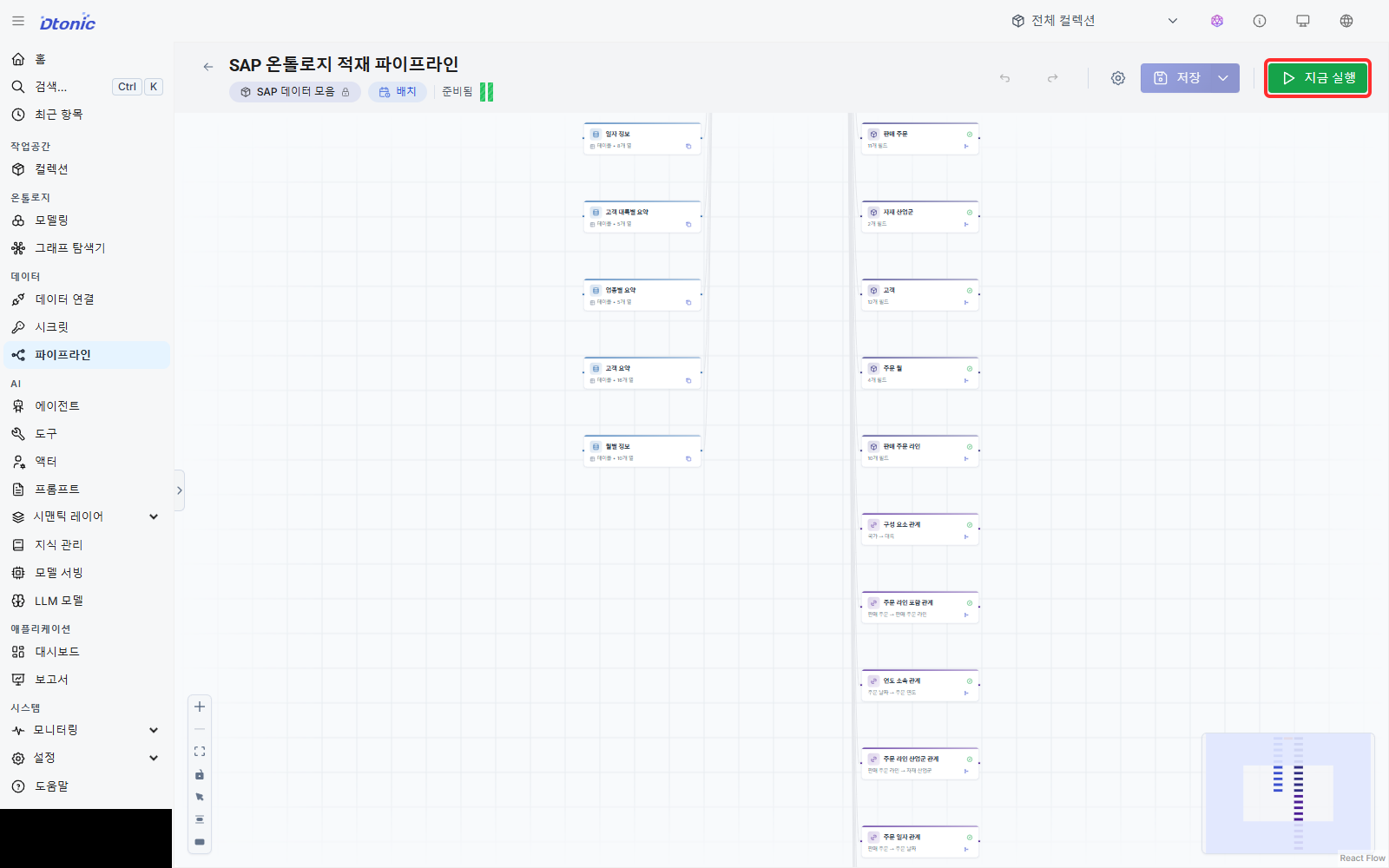
When the run completes, expand one order's context in this order.
- Select the SAP ontology in Graph Explorer.
- Select
sap_customerunder Entities. - Select
Dynamic Industriesand confirm thatcustomer_idis300286. - From the orders returned with the customer, select the node whose
order_idis18622. - Use Expand neighbours on the order to add its line and order date.
- Expand the order-line node to add material type
ZSER.
Switch the result to 3D and select each node to inspect its properties.
Success looks like this
A line connects the customer node to order 18622, its line, material type ZSER, and date
2017-01-13. If the graph shows unlabeled circles, select a node and read its name and ID in the
properties panel.
Interpret the result
The graph does not replace the aggregate conclusion. It verifies that the high-value pattern found in the summaries remains attached to one actual order-line context.
Next decision
The numbers and the relationship path now support the same conclusion. Next, check source joins, duplicate quality, transaction context, and training assumptions before the final month-end answer.