Document AI — from PDF claim parsing to rule-based decisions and audit trails
Follow one claim at fictional insurer VeridianLife and set the boundary between automated handling and human review.
0/7 chapters complete
9:00 a.m. in the VeridianLife claims room
Insurance claims that arrived over the weekend are waiting to be processed. Manual review of every PDF is slow, but trusting every extracted value could let a misread amount or missing diagnosis code drive an automated decision.
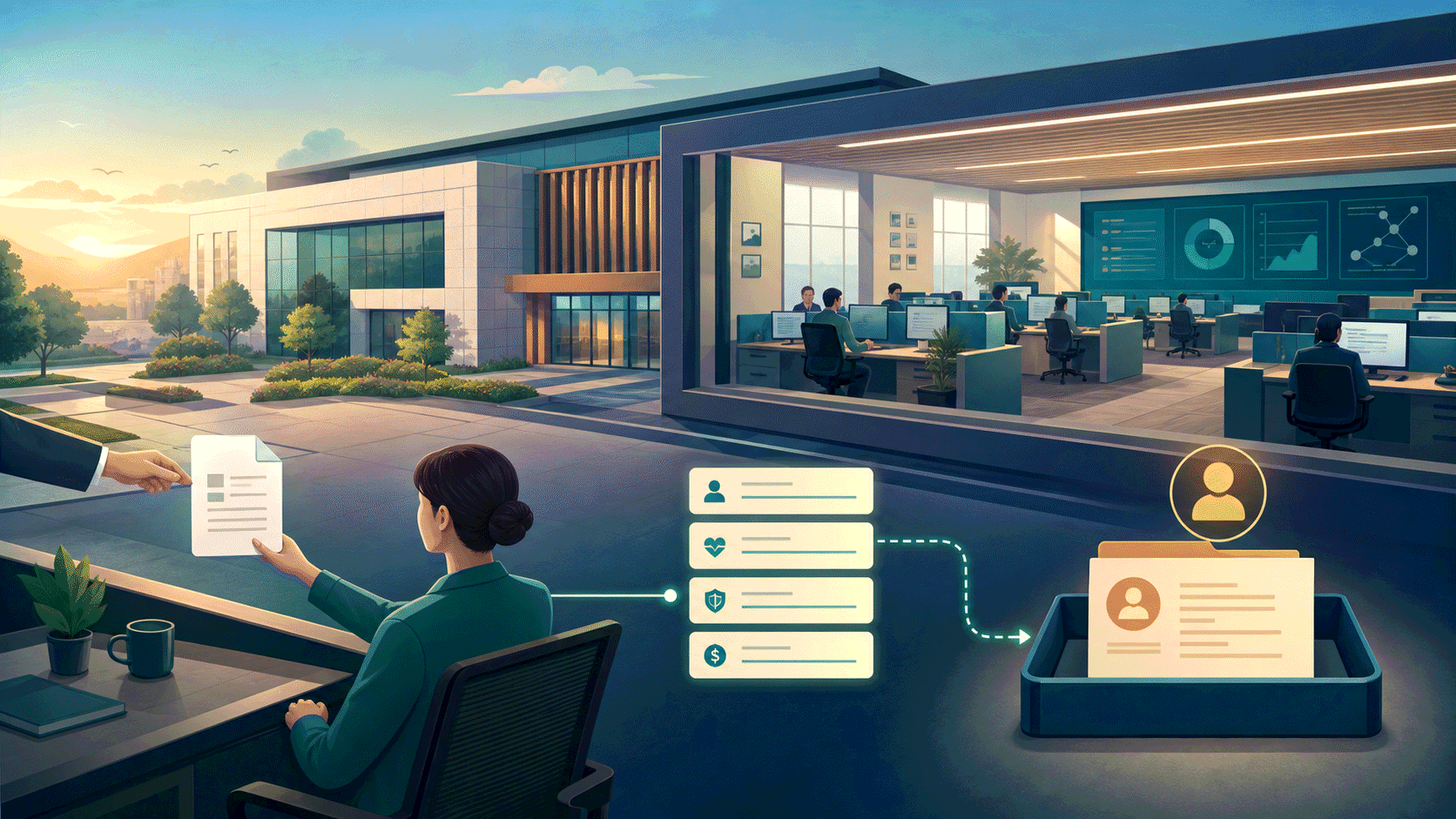
Today you are part of VeridianLife's claims-operations team, deciding whether automation may continue
for CLM-2025-006 or the claim should be handed to a person with evidence.
Which claims can move automatically, and which should be handed to a person with evidence?
Decision criteria for this mission
- Perspectives in play — Processing automation structures repeated documents quickly, while claims review checks whether the extracted values are trustworthy and whether the handoff reason will travel with the case.
- Decision constraints —
CLM-2025-006has an amount and diagnosis code, but itsconfidenceis 0.52, below the 0.6 automation threshold. Having a value and trusting that value are separate decisions. - Completion signals — Separate the source document, intake metadata, and structured result; record
ESCALATEDwith its reason; then recheck the handoff through claimant-policy relationships and the full decision distribution.
Workshop goals
By the end of the Workshop, you will be able to explain four decisions:
- Distinguish values read from the document from values known at intake.
- Decide how far a structured result can be trusted for automated handling.
- Trace the reason automation stopped through data, relationships, and the operations view.
- Explain the complete solution from the opening operations problem to the finished handoff.
From one received claim to an explained result
One claim passes through five scenes: intake, extraction, rule decision, human handoff, and operations review. After an evidence check, the last chapter returns to the opening problem and explains what the flow solved.
Loading the diagram. Mermaid source:
flowchart LR
    accTitle: Five scenes, an evidence check, and a retrospective for one insurance claim
    accDescr: Inspect the claim PDF and intake metadata, judge the structured result, route the claim to automation or human review, verify operations evidence, check the boundary, and explain the solved problem.
    receive["1. Claim intake<br/>Find the first clue"] --> extract["2. Structure the document<br/>Choose trusted values"]
    extract --> decide["3. Apply ordered rules<br/>Handle or hand off"]
    decide --> trace["4. Trace relationships<br/>Recover context"]
    trace --> operate["5. Review operations<br/>Choose the next action"]
    operate --> check["6. Evidence quiz<br/>Check the boundary"]
    check --> reflect["7. Retrospective<br/>Explain the outcome"]
Each chapter resolves one question. Follow the core practice first, and open Deep dive only when you need implementation detail or the full inventory.
Prerequisites
- An analyst or engineer account with D.Hub Portal access (Editor or higher)
- About 43 KB of download space for one ZIP
- 100 minutes of practice time
You do not need a terminal, Python, or a clone of dhub2-examples. If scenario import is new to you,
complete Import and tour a complete hands-on scenario first.
Learning journey
- Find the first clue in one claim15 minImport the scenario and distinguish the source document from intake metadata.
- Decide how far to trust the structured result20 minRun document extraction and read confidence as a signal that separates automated handling from review.
- Stop automation and hand off with a reason20 minApply ordered rules and record both the human-review decision and its reason in decision_log.
- Trace the decision through relationships20 minConnect the claim document to its claimant and policy to recover the context of the escalation.
- Find the same conclusion in the operations view15 minRead the automated and human-review distribution and connect one claim decision to team-wide operations.
- Check the automation boundary5 minBefore the final explanation, review field provenance, the confidence rule, the operations view, and the human handoff in four questions.
- Explain what you solved and finish the Workshop5 minReturn to the opening operations problem and summarize the completed six-stage solution.